The kitchen, long considered the heart of the home, has completed its evolution in 2025 into the home’s central nervous system—a multifunctional hub for nourishment, work, socializing, and wellness. Kitchen remodeling in 2025 is a sophisticated endeavor, blending high-tech integration with a profound commitment to sustainability and personalized comfort. This encyclopedic article provides a comprehensive overview of the prevailing trends, materials, technologies, and methodologies defining kitchen renovation for the modern era. It serves as an essential guide for homeowners embarking on this significant investment and for the contractors and designers tasked with realizing these visions. We will explore the market landscape, deep-dive into design and planning, analyze key innovations, and navigate the practicalities of budgeting, construction, and regulatory compliance.
1. The State of Kitchen Remodeling in 2025: A Market Overview
The kitchen remodeling market in 2025 is characterized by a dynamic interplay of economic factors, technological maturation, and evolving lifestyle priorities. Following the inflationary pressures and supply chain disruptions of the early 2020s, the market has entered a phase of sophisticated stability. Homeowners are increasingly choosing to “improve in place” rather than move, driving a robust demand for high-quality, durable renovations that offer a strong return on investment (ROI) and an even stronger return on lifestyle (ROL).
Market Drivers:
- The “Forever Home” Mentality: With fluctuating housing markets, many homeowners are investing in their current properties with long-term livability in mind. This translates to a demand for timeless designs, durable materials, and features that support aging-in-place.
- Hybrid Work Culture: The kitchen is no longer just for cooking. It often serves as a part-time office, a video conferencing backdrop, and a space for decompressing between tasks. Remodels in 2025 frequently incorporate dedicated work nooks, integrated charging stations, and superior acoustic design.
- Wellness and Sustainability Imperative: There is an unprecedented consumer demand for healthy and environmentally conscious living spaces. This influences every decision, from the specification of low-VOC (Volatile Organic Compound) paints to the selection of energy-efficient appliances and recycled materials.
- Technological Maturity: The “smart home” is no longer a novelty. In 2025, the expectation is seamless integration. The Matter smart home standard has gained significant traction, allowing appliances and devices from different manufacturers to communicate effortlessly. AI-powered kitchen assistants, predictive maintenance alerts, and automated cooking functions are becoming standard features.
According to the 2025 National Kitchen & Bath Association (NKBA) Market Outlook, the average mid-range kitchen remodel cost has settled around $85,000, while high-end remodels frequently exceed $170,000. Significantly, over 70% of homeowners undertaking a remodel state that creating a multifunctional space is their primary motivation.
2. The Planning and Design Phase: A Blueprint for Success
A successful kitchen remodel is 90% planning and 10% execution. Rushing this critical phase is the single most common cause of budget overruns, timeline extensions, and homeowner dissatisfaction.
2.1. Defining Goals and Scope
A Note for Homeowners: Before contacting a single professional, take the time to define your “why.” Are you remodeling for resale, to better accommodate a growing family, to pursue a culinary hobby, or to create a more efficient daily routine? Create three lists:
- Must-Haves: The non-negotiable elements (e.g., a gas range, more counter space, an island with seating).
- Nice-to-Haves: Desires you are willing to compromise on if the budget is tight (e.g., a built-in coffee maker, a second sink).
- Pain Points: Everything you dislike about your current kitchen (e.g., poor lighting, lack of storage, traffic flow issues).
This exercise provides clarity and becomes an invaluable communication tool when working with professionals.
Considerations for Contractors: The initial client consultation is a discovery process. Use active listening to understand not just what the client wants, but how they live. Ask probing questions: “Describe a typical morning in your kitchen.” “How many people cook at once?” “Where do the kids do their homework?” The answers will inform a design that is not just beautiful, but deeply functional. Utilize 3D rendering and virtual reality (VR) walkthrough software to help clients visualize the space, which can prevent costly changes mid-project.
2.2. Budgeting and Financial Planning
A realistic budget is the foundation of a successful project. A common guideline is to allocate 5-15% of your home’s total value to the kitchen remodel. The total cost should be broken down as follows (approximate percentages):
- Cabinetry and Hardware: 30%
- Labor and Installation: 20%
- Appliances and Ventilation: 15%
- Countertops: 10%
- Flooring: 7%
- Lighting and Electrical: 5%
- Plumbing and Fixtures: 5%
- Design Fees, Permits, Other: 8%
- Contingency Fund: 10-20% of the total budget. This is non-negotiable for handling unforeseen issues like hidden water damage or structural problems.
2.3. Assembling the Right Team
Homeowners have several options for project leadership:
- General Contractor (GC): Manages the entire project, including hiring and scheduling subcontractors (plumbers, electricians, painters), sourcing materials, and ensuring code compliance. Ideal for complex projects involving structural changes.
- Kitchen Designer: A specialist who focuses on the layout, functionality, and aesthetic of the kitchen. They create detailed plans, specify materials, and often work in tandem with a GC.
- Design-Build Firm: A single entity that handles both the design and construction phases. This integrated approach can streamline communication and accountability.
Vetting Professionals in 2025:
- Verify Credentials: Check for licenses, insurance (liability and workers’ compensation), and certifications from professional organizations like the NKBA or the National Association of the Remodeling Industry (NARI).
- Digital Portfolio Review: Look for a portfolio that aligns with your desired aesthetic and showcases projects of a similar scope. Pay attention to the quality of finish work.
- Reference Checks: Speak to at least three recent clients. Ask about communication, budget adherence, problem resolution, and overall satisfaction.
2.4. The Modern Kitchen Layout: Beyond the Work Triangle
The classic kitchen “work triangle” (the path between the sink, refrigerator, and range) has evolved. With multiple users and functions, the 2025 kitchen is designed around “Work Zones.”
- Prep Zone: Ample counter space, often with a secondary sink and easy access to knives, cutting boards, and waste/compost bins.
- Cooking Zone: The range/cooktop, wall ovens, and microwave, with nearby storage for pots, pans, and spices.
- Cleaning Zone: The primary sink, dishwasher, and drying racks. Locating this zone outside the primary cooking and prep path prevents bottlenecks.
- Storage Zone: The pantry and refrigerator, ideally located near the kitchen’s entrance for easy unloading of groceries.
- Social Zone: An island or peninsula with seating, kept separate from the main work areas to allow for safe interaction.
- Flex Zone: A small desk area or charging station for managing household tasks or remote work.
The efficiency of these zones can be mathematically considered. For instance, the total travel distance (Dtotal) between key tasks within a workflow should be minimized. Let Pi be the position of a zone (Prep, Cooking, Storage). A simplified workflow (e.g., getting food, prepping, cooking) can be modeled as a path, and the goal is to minimize ∑∣∣Pi+1−Pi∣∣ for common task sequences. Modern design software can simulate these workflows to optimize layouts.
3. Key Design Trends and Innovations for 2025
The aesthetic of the 2025 kitchen is one of “Warm Modernism.” It moves away from the stark, cold minimalism of the past and embraces texture, natural materials, and personalized details.
3.1. Aesthetics and Color Palettes
- Nature-Inspired Hues: Greens (from sage to deep forest), blues (muted and slate), and warm earthy tones like terracotta, ochre, and rich browns are dominant. These colors create a calming, grounding atmosphere.
- Textural Contrast: The interplay of different textures is paramount. Think a rough-hewn stone backsplash against smooth, matte cabinetry, or fluted glass doors next to polished metal hardware.
- “Curated” Kitchens: Open shelving and glass-front cabinets are used judiciously to display curated collections of pottery, glassware, and cookbooks, injecting personality into the space. This is a move away from hiding everything behind solid doors.
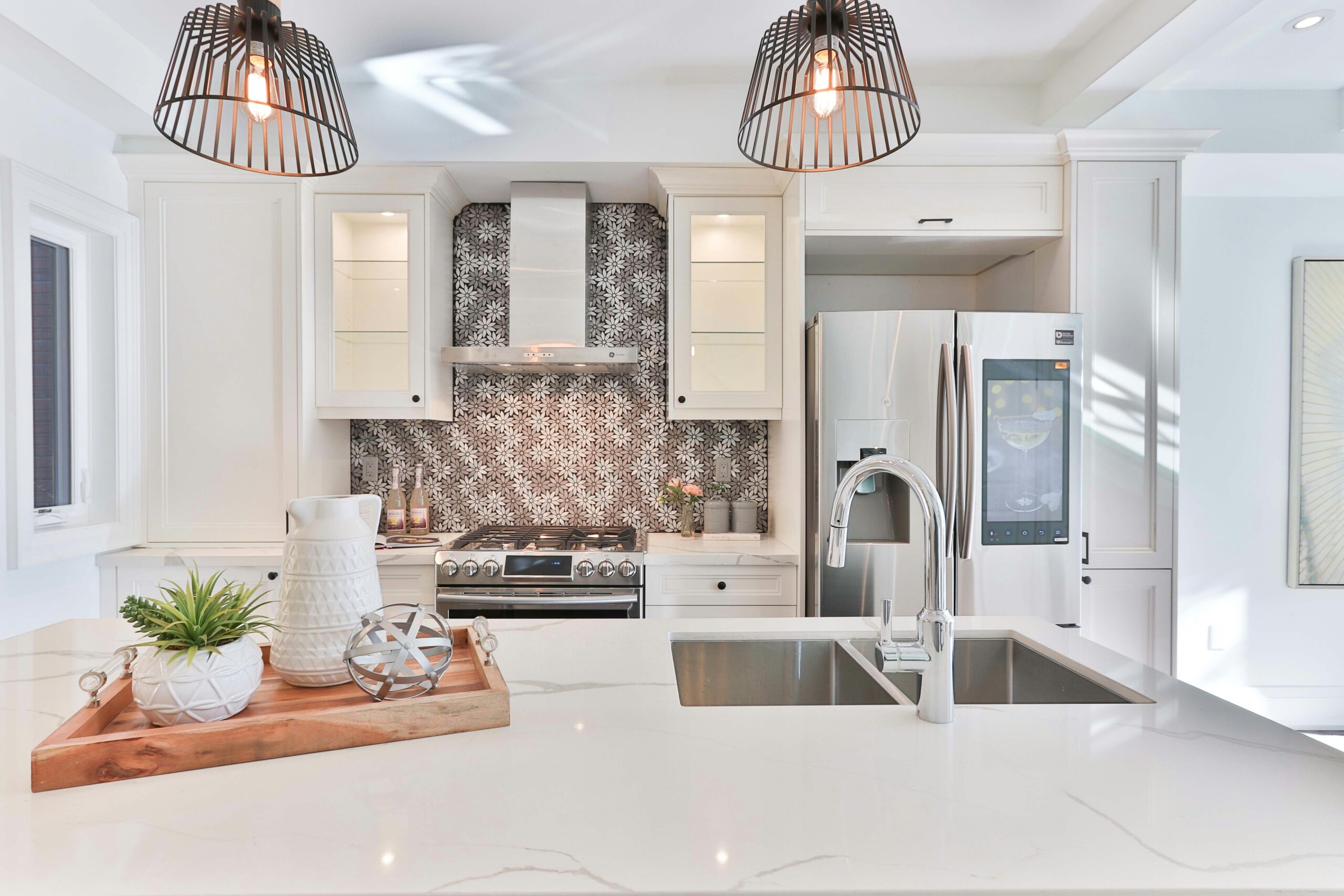
- Statement Stone: Instead of a simple countertop, designers are using slabs of heavily veined marble, quartzite, or sintered stone for the backsplash and even wrapping the entire island for a dramatic, monolithic effect.
3.2. Cabinetry: The New Focal Point
- Flat-Panel and Shaker Hybrids: While the simple Shaker door remains popular, 2025 sees a rise in “Slim Shaker” or “Skinny Shaker” profiles, offering a more contemporary, refined look. Clean, flat-panel doors remain the choice for ultra-modern designs.
- Wood Grains Return: After years of painted white and gray cabinets, natural wood is back in the spotlight. White oak, walnut, and alder in light-to-medium stains are highly sought after for the warmth and organic texture they provide. Mixing wood lowers with painted uppers is a common strategy.
- Innovative Finishes: Matte and super-matte finishes, often with anti-fingerprint properties, are preferred over high-gloss. Fluted and reeded wood surfaces are also used on island fronts and accent cabinets to add depth and visual interest.
- Hardware as Jewelry: Hardware is no longer an afterthought. Artisanal knobs and pulls in materials like unlacquered brass (which develops a natural patina over time), matte black, and polished nickel are used to make a statement.
3.3. Countertops: Performance Meets Panache
- Quartz Still Reigns, But with Nuance: Engineered quartz remains the top choice for its durability and low maintenance. The designs of 2025, however, perfectly mimic the subtle veining and warm tones of natural marble and quartzite, moving away from the artificial, chunky patterns of the past.
- Sintered Stone (Ultra-Compact Surfaces): Brands like Dekton, Neolith, and Lapitec are gaining significant market share. Made by fusing minerals under intense heat and pressure (a process called sintering), these materials are virtually indestructible. They offer extreme resistance to scratches, heat, and UV rays, making them suitable for both indoor and outdoor kitchens. Their compressive strength often exceeds 300 MPa, far surpassing granite.
- Quartzite’s Rise: For those who desire natural stone, quartzite offers the beauty of marble with the durability closer to granite. Its stunning, often dramatic, veining makes it a popular choice for statement islands.
- Thinner Profiles and Unique Edges: While thick, chunky countertops had their moment, 2025 sees a trend toward thinner profiles (around 2 cm) for a sleeker, more European aesthetic. Waterfall edges, where the countertop material flows vertically down the sides of an island, remain a popular high-end feature.
3.4. Appliances: Smart, Seamless, and Specialized
- Induction Cooking is Standard: Driven by sustainability goals and superior performance, induction cooktops have become the default choice in mid-to-high-end remodels. They offer precise temperature control, faster heating, and improved safety. Many models now feature virtual flame displays and flexible cooking zones that can accommodate any pot size.
- The Steam and Air-Fry Combination Oven: The wall oven is now a multi-functional workhorse. Combination steam-convection ovens (for healthier cooking and baking perfect bread) and ovens with built-in air frying capabilities are highly requested.
- Columnar Refrigeration: Instead of a single, bulky refrigerator/freezer unit, homeowners are opting for separate, integrated columns for fresh food, freezer, and even wine storage. This allows for customized food preservation zones and a seamless, built-in look.
- The Disappearing Appliance: Appliance integration is at its peak. Dishwashers and refrigerators are concealed with custom cabinet panels. Downdraft ventilation systems that rise from the countertop eliminate the need for bulky overhead range hoods, preserving open sightlines.
- The Smart Appliance Ecosystem (Matter Protocol): In 2025, smart appliances communicate effectively. A homeowner can preheat their oven on the way home, receive a notification on their TV when the dishwasher cycle is complete, and use a central app to diagnose an issue with the refrigerator. AI-powered ovens can recognize food via an internal camera and suggest the optimal cooking program.
3.5. Lighting: Layered and Human-Centric
Kitchen lighting design in 2025 is a sophisticated, layered approach.
- Ambient Lighting: Recessed ceiling lights, now with “tunable white” technology, provide the overall illumination. The color temperature can be adjusted throughout the day, from a cool, energizing white in the morning (>4000K) to a warm, relaxing glow in the evening (<3000K), aligning with the body’s natural circadian rhythms.
- Task Lighting: Under-cabinet LED strips are essential for illuminating countertops. This is no longer an afterthought; it is integrated directly into the cabinetry for a clean look.
- Accent Lighting: This is where personality shines. A pair of statement pendants over an island, sconces flanking a window, or interior cabinet lighting to highlight display items.
- Integrated Lighting: LED strips are being integrated directly into the cabinet structure, along toe-kicks for a floating effect, and even within drawers, activating upon opening.
4. The Construction and Execution Phase
This phase transforms the digital render into a physical reality. For contractors, meticulous project management is key. For homeowners, patience and clear communication are paramount.
Considerations for Contractors:
- Project Management Software: Tools like Procore, Buildertrend, or CoConstruct are indispensable in 2025 for managing schedules, budgets, change orders, and client communication. A shared client portal provides transparency and reduces misunderstandings.
- Supply Chain Logistics: While the major disruptions of the early 2020s have eased, logistical planning is still crucial. Order long-lead-time items like custom cabinetry and appliances as soon as the design is finalized and deposits are paid. Maintain relationships with multiple suppliers to mitigate the risk of a single point of failure.
- Skilled Labor: The demand for skilled tradespeople remains high. Cultivating a reliable team of subcontractors is a contractor’s most valuable asset. Invest in training and fair wages to retain top talent.
- Site Protection and Dust Management: Homeowners are often living in the house during the remodel. Superior site protection and the use of negative air machines for dust control are no longer optional luxuries; they are standard expectations for professional conduct.
A Note for Homeowners:
- Expect Disruption: Your home will be a construction zone. Set up a temporary kitchen in another room with a microwave, coffee maker, and a small refrigerator. Plan for simple meals or budget for eating out.
- Regular Check-ins: Schedule a brief weekly meeting with your contractor (on-site or virtual) to review progress, ask questions, and address any concerns.
- Change Orders: If you decide to change something after the project has started, it will require a “change order.” This document will detail the new work, the cost, and the impact on the schedule. Be sure you understand and approve it in writing before the work proceeds.
5. Budgeting, Costs, and Return on Investment (ROI)
Understanding the financial implications of a kitchen remodel is essential for both homeowners and contractors.
5.1. Understanding Cost Drivers
- Scope: The single biggest factor. Moving walls, changing plumbing/gas lines, or altering electrical layouts will significantly increase costs compared to a cosmetic “pull-and-replace” remodel.
- Material Quality: The difference between stock laminate countertops and a custom-fabricated quartzite slab can be tens of thousands of dollars. The same applies to cabinetry, appliances, and flooring.
- Location: Labor and material costs vary significantly by region. Major metropolitan areas have higher costs than rural areas.
5.2. Calculating Return on Investment (ROI)
The ROI of a kitchen remodel depends on the project’s scope, the quality of the work, and the local real estate market. The formula is:
ROI=Remodel Cost(Value Added to Home−Remodel Cost)×100%
According to 2025 remodeling impact reports, a minor-to-mid-range kitchen remodel recoups, on average, 75-85% of its cost at resale. An upscale, highly customized remodel may recoup a lower percentage (e.g., 55-65%), but its primary benefit is the “Return on Lifestyle” for the current owner.
To Maximize ROI:
- Stick to a timeless, broadly appealing design.
- Prioritize functional improvements over niche luxury items.
- Ensure the quality of the kitchen is consistent with the rest of the home and the neighborhood.
- Invest in energy-efficient appliances and durable, low-maintenance surfaces.
6. Sustainability and Wellness in the 2025 Kitchen
The “healthy home” movement has fully arrived in the kitchen, focusing on both planetary health and the well-being of the occupants.
- Sustainable Materials: Look for cabinetry made from FSC-certified wood or rapidly renewable materials like bamboo. Countertops made from recycled glass or paper composites are gaining popularity. Circular economy principles are also emerging, with some manufacturers offering buy-back programs for old appliances and cabinets.
- Energy Efficiency: ENERGY STAR rated appliances are a baseline requirement. Induction cooktops are inherently more energy-efficient than gas or electric coil, transferring approximately 85% of their energy to the pot, compared to about 40% for gas.
- Water Conservation: Faucets and dishwashers with the EPA’s WaterSense label use at least 20% less water than standard models. Hands-free, motion-sensor faucets also help reduce water waste.
- Indoor Air Quality: This is a major concern. Specify low-VOC or zero-VOC paints, primers, adhesives, and finishes. Ensure cabinetry is made from materials that do not contain urea-formaldehyde. A high-quality, properly-vented range hood is critical for exhausting combustion byproducts, grease, and moisture.
7. Technology and the Smart Kitchen of 2025
Beyond individual smart appliances, the truly “smart” kitchen of 2025 is an integrated, responsive environment.
- Integrated Hubs: Smart screens (like the Amazon Echo Show or Google Nest Hub) are often built directly into the backsplash or refrigerator, serving as the central command center for controlling appliances, managing grocery lists, displaying recipes, and video chatting.
- Automated Grocery and Pantry Management: Smart refrigerators with internal cameras can identify items, track expiration dates, and automatically add items to a shopping list. Smart pantry systems with sensors can do the same for dry goods.
- AI-Powered Cooking Assistance: AI is enhancing the cooking process. Ovens with food recognition suggest cooking modes, smart cooktops with temperature sensors prevent burning, and connected apps guide users through complex recipes step-by-step.
- Voice Control: The ability to control lighting, faucets, and appliances with voice commands provides a hands-free, hygienic, and convenient user experience. “Hey Google, preheat the oven to 200∘C.”
8. Legal, Permits, and Regulations
Navigating the administrative side of a remodel is a critical task for the contractor and an important area of awareness for the homeowner.
- Building Permits: A permit is almost always required if you are moving walls, altering plumbing or electrical systems, or changing the building’s envelope. The contractor is typically responsible for securing permits, and the cost should be included in the contract. Working without a required permit can result in fines, forced removal of the work, and major issues when selling the home.
- Contracts: A detailed contract is essential protection for both parties. It should include:
- A detailed scope of work.
- A full list of specified materials and model numbers.
- Total cost and a clear payment schedule.
- A projected start and completion date.
- Procedures for handling change orders.
- Proof of the contractor’s liability insurance and workers’ compensation.
- Code Compliance: All electrical and plumbing work must be done by licensed professionals and must comply with local and national building codes. This is non-negotiable for safety and legality.
9. Conclusion and Future Outlook
The kitchen remodel of 2025 is a far cry from the simple cabinet and countertop swaps of the past. It is a holistic reimagining of the home’s most vital space—a sophisticated blend of warm aesthetics, intelligent functionality, and deep-seated principles of wellness and sustainability. For homeowners, it represents a significant investment in their quality of life. For contractors and designers, it demands a mastery of new technologies, materials, and integrated design principles.
Looking ahead, we can anticipate even deeper integration of AI, with kitchens that learn family preferences and suggest meal plans based on available ingredients and dietary needs. Materials science will continue to evolve, bringing self-healing surfaces and even more resilient, eco-friendly options. The kitchen’s role as the command center of the home will only intensify, making thoughtful, professional remodeling more essential than ever. The result is a space that is not only beautiful and efficient but also intelligent, healthy, and perfectly attuned to the rhythms of modern life.